- Epoch Morning Brief
- Posts
- What Trump’s National Security Strategy Means for Canada
What Trump’s National Security Strategy Means for Canada

Epoch Morning Brief
December 26, 2025

U.S. President Donald Trump arrives to announce the creation of the “Trump-class” battleship during a statement to the media at Trump’s Mar-a-Lago estate in Palm Beach, Fla., on Dec. 22, 2025. (Tasos Katopodis/Getty Images)
Canada receives but a passing mention in the recently released U.S. National Security Strategy, but that doesn’t mean it will not have an impact here.
In many ways, it already does. Canada as a neighbour was among the first countries to be affected by key policy changes brought forth by U.S. President Donald Trump.
Aside from hard security and economics, Trump’s National Security Strategy also puts significant focus on somewhat more of a cultural concern—and that is civilizational decline.
The strategy says that the path followed by some European countries on regulation and immigration will lead to their demise. While Canada is not mentioned specifically, it applies similar policies.
Trump’s National Security Strategy is dated November 2025 and was publicly released in early December.
Early Impact
Pillars of Trump’s new strategy, such as the focus on border security and trade issues, were put in practice shortly after he became president.

Canadian and American flags fly near Ambassador Bridge at the Canada-U.S. border crossing in Windsor, Ont., on March 21, 2020. (The Canadian Press/Rob Gurdebeke)
This came by way of threatening and later subjecting Canada and Mexico to blanket tariffs, with Trump accusing both countries of fuelling illegal immigration and drug trafficking with lax border controls. In response, Canada and Mexico implemented various measures to assuage Trump’s concerns.
Tariffs have not only been used to press other countries in changing policies, but also to bring back manufacturing to the United States. This re-industrialization goal is also a plank of the new National Security Strategy that has had a significant impact on Canada.
Even though the metals and car industries are deeply integrated across the border, Canada has not been spared from Trump’s sectoral tariffs imposed on national security grounds.
Overarching Goal
The key objective of the U.S. strategy suggests a deep worry within the Trump administration about the future of the United States, as “survival” of the country tops the list.
“First and foremost, we want the continued survival and safety of the United States as an independent, sovereign republic whose government secures the God-given natural rights of its citizens and prioritizes their well-being and interests,” it says.
This is to be achieved by protecting the country from threats such as military attacks, “cultural subversion,” drug trafficking, and “hostile foreign influence.”
A variety of methods can be used to deal with such threats, and the U.S. strategy identifies border security as the “primary element” of national security.
Trump had campaigned on closing the southern border and on conducting the largest deportation operation in the country’s history.
Both measures have been aggressively pursued in 2025, resulting in record-low numbers of illegal crossers encountered by Customs and Border Protection in the new fiscal year. The Department of Homeland Security also said in December that more than 2.5 million illegal immigrants have left the country since January 2025, with more than 605,000 being deported.
On the Canadian side, Trump’s threat of tariffs in late 2024 led Ottawa to announce a $1.3 billion border plan to increase personnel and technologies deployed at the boundary. Canada also followed the U.S. lead in listing transnational criminal groups as terrorist entities.

Prime Minister Mark Carney holds a press conference with Foreign Affairs Minister Anita Anand and National Defence Minister David McGuinty following the NATO Summit in The Hague, Netherlands, on June 25, 2025. (The Canadian Press/Sean Kilpatrick)
On the legislative side, the Liberal government managed to pass the second iteration of its border security bill in the House of Commons before the Christmas break. It includes measures to give increased powers to border guards and to strengthen immigration rules.
Foreign Policy
Aside from impacting border dynamic, the U.S. National Security Strategy informs Washington’s foreign policy, which necessarily affects Canada, especially on key international files.
The new strategy seeks to break from previous administrations and effectively decades of U.S. foreign policy by changing the framework through which Washington approaches world events.
“After the end of the Cold War, American foreign policy elites convinced themselves that permanent American domination of the entire world was in the best interests of our country,” says the strategy. “Yet the affairs of other countries are our concern only if their activities directly threaten our interests.”
This does not mean Trump wants a diminished world standing for the United States, as he still seeks to maintain and expand the country’s economic and military superiority. The purpose rather appears to narrow the focus in a bid to preserve resources and protect core interests.
What could be seen as an American pullback is to be compensated by what the strategy calls “burden-sharing and burden-shifting.”
“The days of the United States propping up the entire world order like Atlas are over,” says the strategy, which adds that U.S. allies and partners have the means to play a larger role in collective defence by assuming responsibility in their respective areas.
A direct result of this policy change has been NATO members being pressed by Trump to meet the defence spending guideline of 2 percent of GDP this year, and agreeing in June to raise the bar to 5 percent by 2035.

An RCAF CF-18 takes off from CFB Bagotville, Que., on June 7, 2018. (The Canadian Press/Andrew Vaughan)
“The United States will stand ready to help—potentially through more favorable treatment on commercial matters, technology sharing, and defense procurement—those [countries] that willingly take more responsibility for security in their neighborhoods and align their export controls with ours,” says the strategy.
The government of Prime Minister Mark Carney has increased defence spending this year to meet the 2 percent target and has welcomed the new target.
New Monroe Doctrine
While there is alignment on the defence spending file between Canada and the United States, some other moves by Trump in line with the National Security Strategy are raising concerns in Ottawa.
This includes Trump’s stated interest in Greenland, which belongs to Denmark. “We need Greenland for national security,” Trump said on Dec. 22. “We have to have it.”
The next day, in response, Foreign Affairs Minister Anita Anand said she spoke to her Danish counterpart Lars Løkke Rasmussen to “convey Canada’s support for the fundamental importance of respect for sovereignty and territorial integrity.” Trump’s talk of seeking to make Canada the 51st U.S. state made waves early in his mandate.
While the new strategy suggests the United States is pulling back from an interventionist role, it also says the Trump administration is pursuing its version of the Monroe Doctrine. This refers to the U.S. policy articulated by President James Monroe in 1823, stating that European encroachment in the Western Hemisphere would be perceived as a hostile act against the United States.
Fast-forward to 2025 and the actors have changed, with U.S. concerns on the continent stemming more from states like China and from activities conducted by transnational crime organizations.
The strategy says the United States is seeking to “enlist” friends in the Hemisphere to stop drug trafficking, control migration, and increase security on land and sea. “We will reward and encourage the region’s governments, political parties, and movements broadly aligned with our principles and strategy,” it says.
Another goal is to “expand by cultivating and strengthening new partners.”
Some of the Trump administration’s concerns in the Hemisphere have included a Hong Kong company’s ownership of two ports at the Panama Canal, with the White House saying Chinese control of the canal is “unacceptable.” A deal to sell the ports to a group led by American investment firm BlackRock has yet to materialize.
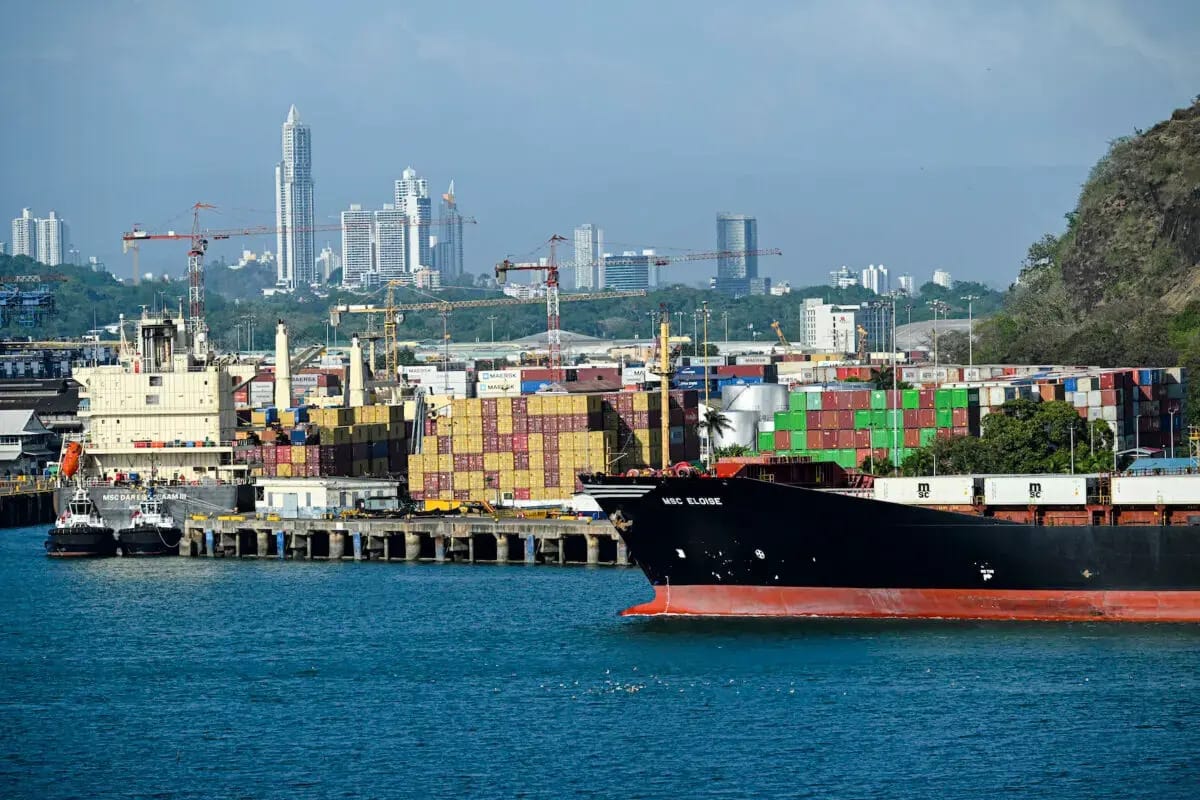
A cargo ship waits at Balboa Port before crossing the Panama Canal in Panama City on Feb. 4, 2025. (Martin Bernetti/AFP via Getty Images)
On the military side, the United States has been flexing its muscles for weeks with deployments near Venezuela. Activities have included striking boats said to be carrying drugs and seizing oil tankers. One of the tankers had been carrying “illicit oil” in a “shipping network supporting foreign terrorist organizations,” said U.S. Attorney General Pam Bondi.
China
Concerns about China outside the Western Hemisphere also drive major aspects of the National Security Strategy.
It remains to be seen how Canada will navigate this aspect as it seeks to re-engage with China after years of limited high-level diplomatic contacts.
The National Security Strategy says the United States had three decades of “mistaken ... assumptions,” thinking that by opening its markets to China and investing there, the country would join the “so-called ‘rules-based international order.’” It adds that this did not happen—with China getting rich and using its power to its advantage.
The strategy blames “American elites” from the two main political parties of having either been “willing enablers of China’s strategy or in denial.”
The U.S. strategy entails rebalancing the economic relationship with China while also preventing war in the Indo-Pacific.
“Trade with China should be balanced and focused on non-sensitive factors,” says the strategy.
Prime Minister Carney has not spoken about reducing the trade deficit with China, which stood at $57 billion in 2024, but he has said increased cooperation could be done around non-sensitive sectors.
The only mention of “Canada” in the National Security Strategy is in relation to how the United States wants to see its allies address China’s economic output, which stands accused of flooding foreign markets with products.
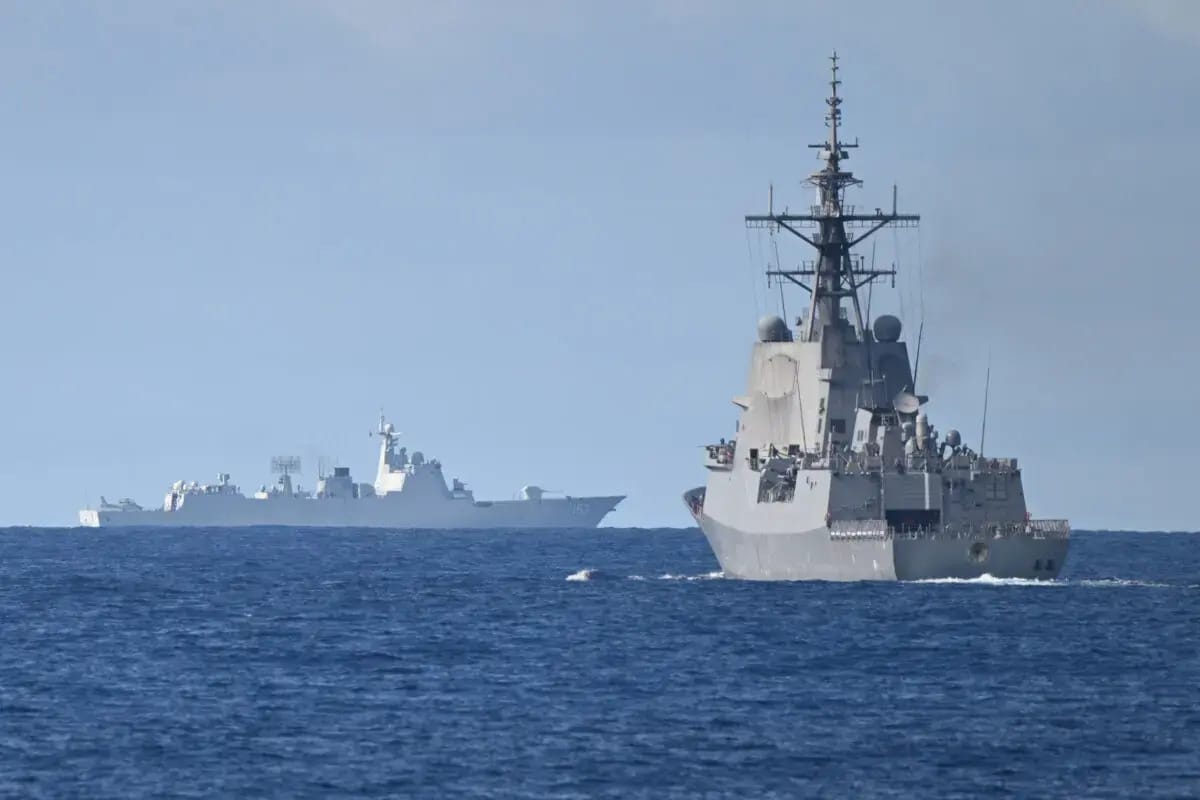
A Chinese People’s Liberation Army (PLA) navy ship (background L) is seen while the an Australian Navy destroyer (R) takes part in a maritime cooperative activity near Scarborough Shoal, on Sept. 3, 2025. (Ted Aljibe/AFP via Getty Images)
“We must encourage Europe, Japan, Korea, Australia, Canada, Mexico, and other prominent nations in adopting trade policies that help rebalance China’s economy toward household consumption, because Southeast Asia, Latin America, and the Middle East cannot alone absorb China’s enormous excess capacity,” it says.
Cultural Concerns
The National Security Strategy devotes sizeable attention to cultural issues, some of which have a direct link to policies pursued by Ottawa.
The strategy says Washington will make efforts to ensure that countries that say they respect freedom of religion and free speech adhere to those principles.
“We will oppose elite-driven, anti-democratic restrictions on core liberties in Europe, the Anglosphere, and the rest of the democratic world, especially among our allies,” it says.
Trump officials have regularly criticized policies in Europe that they say have led to the stifling of free expression.
The State Department on Dec. 23 announced visa sanctions against five individuals said to be involved in the censoring of American speakers and companies.
The Trump administration has already criticized major Liberal legislation in Canada impacting the online space and U.S. businesses, such as the Online News Act and the Online Streaming Act. Both require U.S. companies to transfer funds to Canadian entities.
It remains to be seen whether the White House wades into other controversies, including the Liberals’ hate crime bill that was recently amended to remove the religious defence to hate speech. Ottawa also wants to introduce its online harms legislation in the new year, the third time in doing so. Previous attempts would have created an internet censorship regime with steep penalties.
Other criticism the National Security Strategy directed at Europe could apply to Canada. It notes the lack of military spending and economic stagnation of the continent, due to “national and transnational regulations that undermine creativity and industriousness.”
While these problems are identified as sizeable, the strategy says there’s a bigger problem.
“This economic decline is eclipsed by the real and more stark prospect of civilizational erasure,” says the strategy.
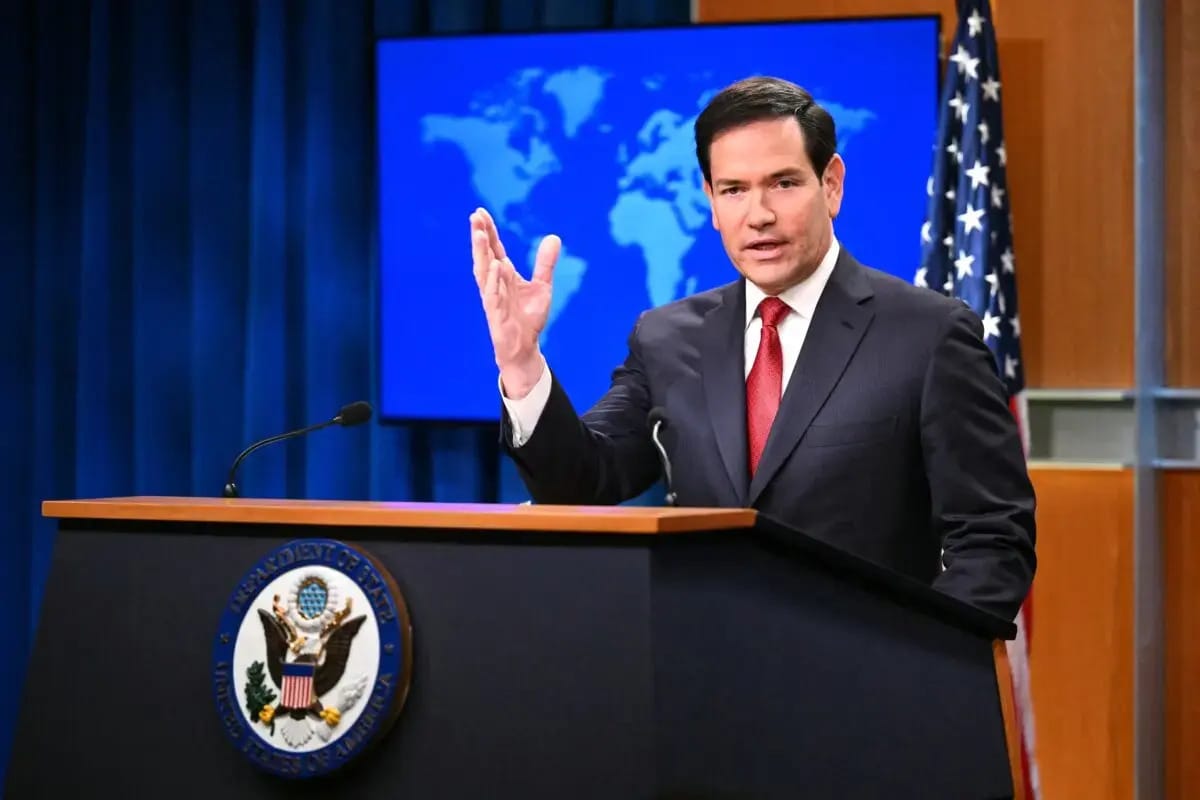
U.S. Secretary of State Marco Rubio speaks during an end-of-year press conference in the State Department Press Briefing Room in Washington on Dec. 19, 2025. (Photo by Mandel NGAN / AFP)
“The larger issues facing Europe include activities of the European Union and other transnational bodies that undermine political liberty and sovereignty, migration policies that are transforming the continent and creating strife, censorship of free speech and suppression of political opposition, cratering birthrates, and loss of national identities and self-confidence.”
Should this trend continue, the strategy says, Europe will be “unrecognizable in 20 years or less,” with NATO countries becoming majority non-European.
“As such, it is an open question whether they will view their place in the world, or their alliance with the United States, in the same way as those who signed the NATO charter.”
The strategy says the United States will seek to “help Europe correct its current trajectory.”
This will involve pushing Europe to ensure its own defence while “cultivating resistance” to the current trajectory within European nations.