- Epoch Morning Brief
- Posts
- Tracing the Billions Spent on Net-Zero at All Levels of Government in Canada
Tracing the Billions Spent on Net-Zero at All Levels of Government in Canada

Epoch Morning Brief
December 21, 2025

Cattle graze on a wind farm in southern Alberta in a file photo. Renewable generation projects have received government incentives through various programs. (Ramon Cliff/Shutterstock)
The Ottawa-Alberta memorandum of understanding links approval of a pipeline to B.C.’s coast with the $16.5 billion Pathways Alliance carbon capture project, for which industry players are counting on significant government support. While the sum may seem substantial, it represents just a fraction of the vast pool of Canadian taxpayer funds being directed by all levels of government to net-zero-emissions-related initiatives across the country.
These funds include billions in domestic policies as well as a $5.3 billion “international climate finance commitment” that Ottawa announced in 2021 for multi-year funding dedicated to helping developing countries “combat climate change.”
In 2024 alone, federal spending on environmental protection increased by 35.6 percent to reach $24 billion, a significant chunk of which is earmarked for emissions reduction.
For comparison, Alberta earmarked $28 billion for operating health care expenses in its 2025 budget, and federal transfers to the provinces for the next fiscal year are estimated at $108 billion, half of which is for health care.
The following is a snapshot of major climate-related programs and expenditures. As all levels of government have these funds interwoven in multiple levels of funding, subsidies, and other policies, the scale is substantial, so the list only includes select examples for illustration.
Federal Spending
In its first budget in early November, the government of Prime Minister Mark Carney reinforced and extended a suite of investment tax credits supporting “clean energy” and net‑zero emissions projects. They include refundable credits of up to about 60 percent for carbon capture, 30 percent for clean technology and clean‑technology manufacturing, and up to 40 percent for clean hydrogen—as part of the government’s Climate Competitiveness Strategy.
From a budgetary perspective, tax credits are a form of government spending. Offering tax breaks for “clean technology” projects, such as carbon capture, reduces revenue that must ultimately be offset—either through higher taxes elsewhere or increased public debt.
In July 2024, the Parliamentary Budget Officer (PBO) calculated that just six tax credits for “clean energy and technology sectors” would cost Canada $103 billion for the 13-year period from 2022–23 to 2034–35. Those tax credits include electric vehicle (EV) supply chain and clean electricity tax credits in addition to the four tax credits mentioned above.
Infrastructure & Homes
The Canada Infrastructure Bank (CIB), a Crown corporation that funds infrastructure projects and has $54.4 billion in capital value, directs a significant portion of its funds toward “green infrastructure” and “clean power.”
A typical example of the type of green projects funded by the CIB is up to $100 million earmarked for “energy efficient building upgrade projects” such as “LED lighting conversion, high efficiency electrified HVAC, onsite solar plus battery storage, and other emission reducing technologies.”
Meanwhile, the federal “Canada Greener Homes Grant” disbursed grants funding for “energy-efficient upgrades” on private homes—including upgrading insulation, replacing windows or doors, or installing solar panels. All in all, this seven-year grant program, launched in May 2021, was expected to cost $2.6 billion. The program is no longer accepting new applicants.
Agriculture
The “On-Farm Climate Action Fund,” first announced in Budget 2021, is a $704 million initiative that distributes grants to help farmers adopt management practices that store carbon and reduce greenhouse gas emissions. A 2025–28 expansion of the fund will give out an additional $300 million to support farmers’ efforts to “become more climate resilient.”
Transportation & Electric Vehicles
The federal government offered EV rebates of up to $5,000 starting in 2019. This program paused in January 2025 after funding ran out. Other transportation-focused programs include funding for railway climate adaptation and public transit decarbonization projects.
The federal government, along with some provinces, has also earmarked billions in subsidies for EV and EV battery plants, some of which have since been cancelled.
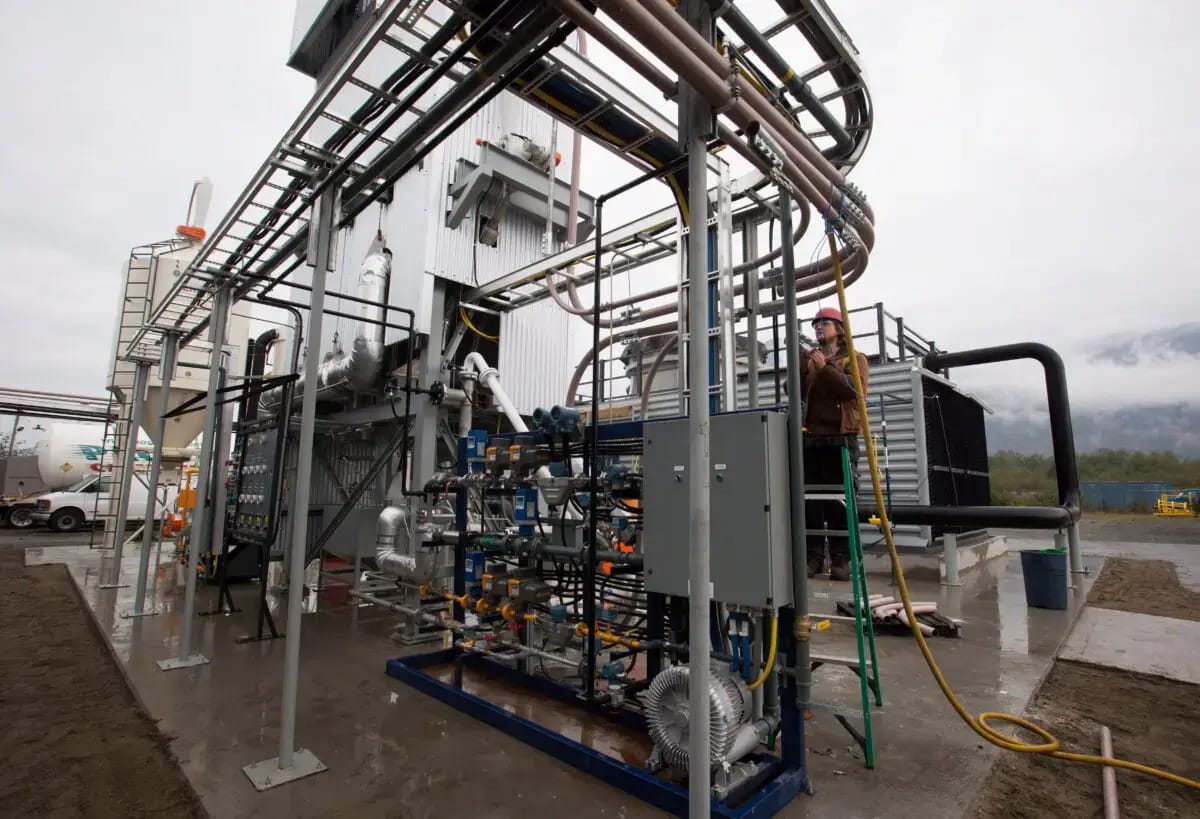
A carbon-capture plant in Squamish, B.C., in a file photo. (The Canadian Press/Darryl Dyck)
First Nations
Some climate programs are broader, such as the over $2 billion in federal funds that have been announced since 2020 for “climate action by Indigenous Peoples,” including helping First Nations and Inuit peoples in “managing the health impacts of climate change.”
Youth Funding
The 2025 budget further directs $40 million over the next two years, starting in 2026–27, to create a Youth Climate Corps, providing “paid green skills training and job placements” for youth who will “be trained to quickly respond to climate emergencies.”
A Canada-wide Youth Climate Corps was pushed for in a campaign first launched in March 2023 by the Climate Emergency Unit, a project of the David Suzuki Institute, which describes the idea as “a bold new public program that would employ tens of thousands of young Canadians in climate-related work, providing good pay and careers in the growing clean economy.”

The funding comes on the heels of other youth-focused climate spending. In July 2025, the federal government announced it would be devoting $14.4 million to “empower young Canadians to address climate change.” This includes $1.8 million for the BC Parks Foundation to “develop the environmental literacy and leadership of young Canadians in British Columbia.”
Trudeau-Era Programs
The Carney government is phasing out some of the flashier Trudeau-era climate grant programs, notably a $3.2 billion fund to plant two billion trees across Canada between 2021 and 2031. The 2 Billion Trees program promised to “help Canada exceed its 2030 Paris Agreement greenhouse gases emissions reduction target and establish the building blocks to get to net zero by 2050.”
At the same time, long-standing grant disbursements like the Green Municipal Fund (GMF), which grew from $125 million in 2000 to $1.625 billion by 2023, remain in place.
A wide variety of projects appear to qualify for this fund. Grants have ranged from $11,000 for a Vancouver Island municipality to study the feasibility of “making its new RCMP detachment building a net zero facility” to $72,500 for Brandon, Manitoba, to study the feasibility of reducing carbon emissions from the city government’s vehicle fleet.
International Financing
Federal climate spending does not stop at Canada’s borders—much of the money is overlooked in Canada because it is earmarked to help foreign countries “combat climate change.”
From 2015 to 2022 alone, Canada disbursed over $8.7 billion “in international climate finance to developing countries.”
While the Carney government’s first budget scales back foreign aid generally, it is maintaining Canada’s strategy of helping other countries respond to climate change. At the COP30 climate summit held in Brazil in November, Ottawa announced $392 million for “inclusive, locally led climate solutions” in developing countries.
This new round of climate funding includes $106 million to launch the Inclusive Climate Action Fund, which will give financing to businesses in Latin America and the Caribbean “to advance climate mitigation and adaptation projects.” Also included is $263 million dedicated to the International Fund for Agricultural Development to “strengthen smallholder farmers’ resilience and adaptive capacity in developing countries.”
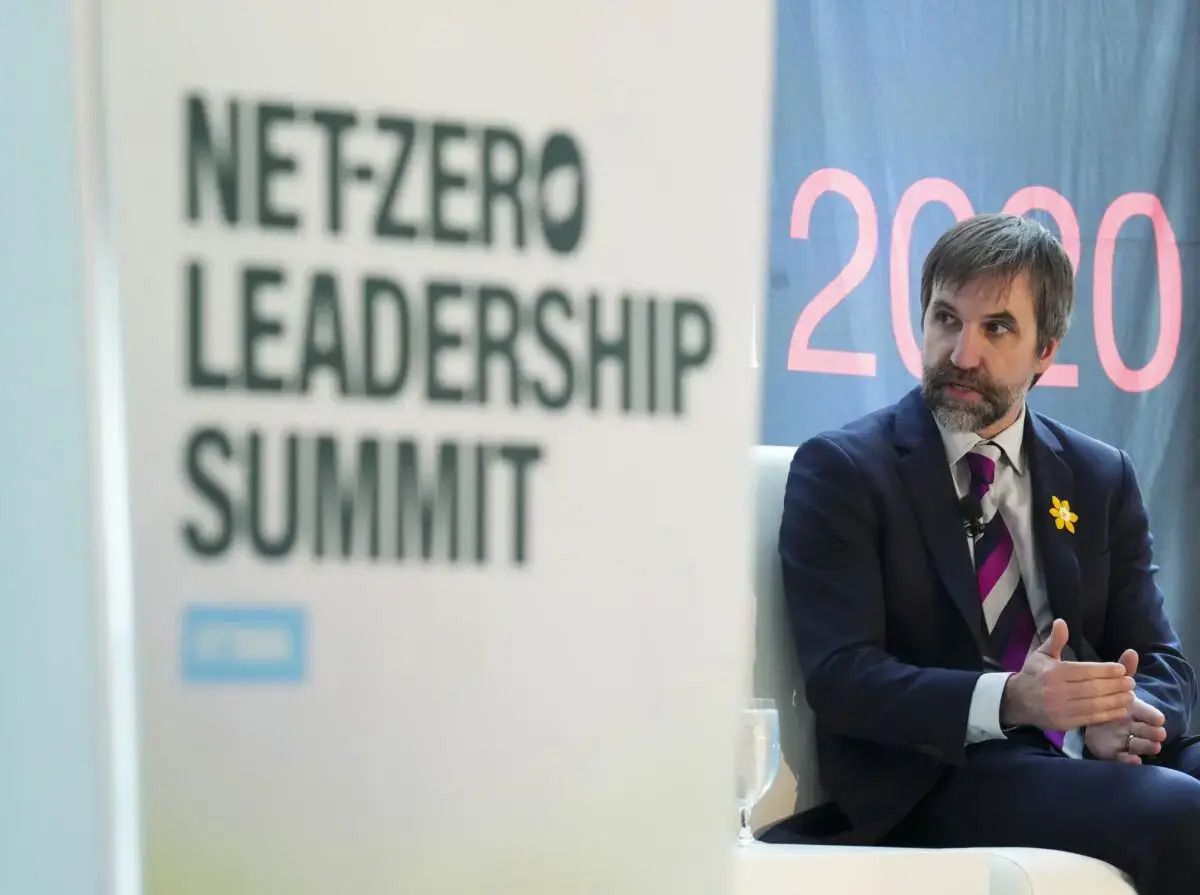
Then-Environment Minister Steven Guilbeault speaks during the Canada 2020 Net-Zero Leadership Summit in Ottawa on April 19, 2023. (The Canadian Press/Sean Kilpatrick)
Provincial Funding
Ottawa is not alone in dedicating a significant portion of its spending toward climate-related goals—the provinces have also adopted this strategy.
Every province is devoting a portion of its public funds to emission-reduction initiatives in some form. Much of the provincial climate spending consists of giving grants or tax breaks to companies in the carbon capture or renewable energy sectors.
A Fraser Institute study released in October estimated that Ottawa and the four largest provinces—Quebec, Ontario, Alberta, and B.C.—provided no less than $158 billion from 2014–15 to 2024–25 in spending and tax credits to support a “low-carbon economy.”
This estimate only goes part way toward capturing the full picture. It specifically focuses on spending and tax credits devoted to creating a “low-carbon” economy in Canada—but climate spending can encompass measures ranging from fostering youth awareness to climate initiatives in developing countries.
Ontario
Ontario’s Ministry of the Environment estimates that it will spend roughly $15.7 million on “climate change and resiliency” in 2025–26.
Like other levels of government, some of Ontario’s climate-related spending is indirect. For example, the Ford government allocated $92 million in its 2025 budget for the ChargeON program, which supports the installation of EV charging stations across the province.
Ontario has committed billions of dollars in provincial subsidies and tax incentives to support the EV supply chain since 2020, as part of joint federal-provincial efforts that together amount to more than $20 billion.
This figure includes commitments made as part of collaborative agreements with the federal government and private companies. Some of the financial support was earmarked for battery plants for companies like Stellantis-LGES in Windsor, Honda in Alliston, and Volkswagen in St. Thomas. The Ford Motor Company also received funding to transform the Oakville plant for EV manufacturing.
The exact amount already disbursed can be difficult to track because some of the payments are contingent on job creation or a company achieving specific benchmarks, while other funding is provided as future tax credits.

Ontario Premier Doug Ford speaks as then-Prime Minister Justin Trudeau listens at an event announcing plans for a Honda electric vehicle battery plant in Alliston, Ont., on April 25, 2024. (The Canadian Press/Nathan Denette)
The Prairies
Alberta has committed billions of dollars toward carbon capture, utilization, and storage projects and programs. The province primarily uses revenue from its Technology Innovation and Emissions Reduction (TIER) system—generated from the carbon price paid by large emitters—to fund emission-reduction projects through agencies like Emissions Reduction Alberta (ERA) and Alberta Innovates.
ERA has disbursed $991.7 million to kickstart “the pilot, demonstration, and deployment of clean technology solutions that reduce emissions” since 2009.
The TIER-funded organization also launches open competitions for companies engaged in climate-related projects, such as the Tailings Technology Challenge. This is a $50 million fund launched by ERA this year to disburse funding to projects—up to $15 million each—that “help reduce and manage oil sands mine water and tailings.”
Manitoba also has initiatives on the go including an EV rebate program, a “merit-based” funding program to support GHG emissions reduction, a Climate Action Fund to invest in green projects, and Efficiency Manitoba, a Crown corporation that offers programs and financial support to homes, businesses, and communities in a variety of areas such as heat pumps and energy retrofits.
Saskatchewan’s climate change strategy involves provincial initiatives like the Saskatchewan Technology Fund, which invests in projects that reduce emissions intensity, and various initiatives to achieve a net-zero electricity grid by 2050.
British Columbia
B.C. was the first province in Canada to adopt a carbon tax, and net-zero emissions initiatives have long been a major focus of the province.
The province disbursed more than $650 million in funding to encourage EV adoption since 2011. Buyers in B.C. could previously combine the province’s $4,000 rebate with Ottawa’s $5,000 rebate for a $9,000 total. B.C. ended its EV rebates this year after much debate.
A number of other provinces have experimented with EV rebates, with Ontario handing out $14,000 rebates until they were cancelled by Premier Doug Ford in 2018.
While EV rebates might be falling out of favour, this does not mean B.C. is necessarily hitting the brakes on climate spending. The province spent an estimated $817 million on “climate-related initiatives” in 2024–25 and is forecast to spend another $590 million in 2025–26. The spending consists of investments in reducing carbon emissions across a range of sectors, including “cleaner industry,” “cleaner buildings,” and “cleaner transportation.”
Quebec
Quebec is focusing heavily on climate spending, much of which centres on the province’s “2030 Plan for a Green Economy,” which “guides the government’s action to reduce greenhouse gas emissions and adapt to climate change over the course of this decade.”
This plan was initially given $6.7 billion for an implementation plan for 2021–26, and in June 2025 was given another $10.1 billion for 2025–30. It is funded mostly by its carbon market, focusing on electrifying transport, greening buildings, boosting industry, and protecting nature.
Quebec has also moved ahead on climate commitments in other ways, including a ban on the sale of gas-powered cars in 2035, a prohibition that the province eased in September to provide “respite” for the automobile industry. The new target requires 90 percent of new cars sold to be zero-emission by 2035, rather than 100 percent.
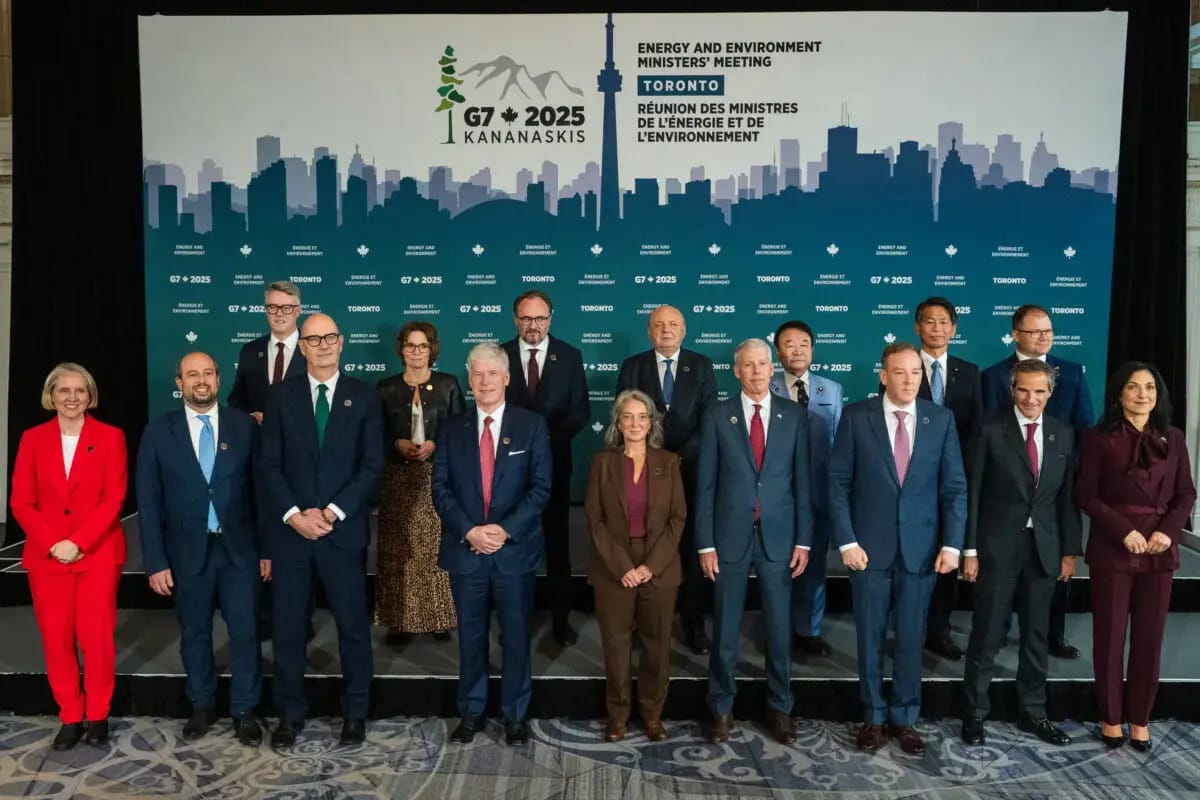
Minister of the Environment Climate Change Julie Dabrusin (front, 5-L) and Minister of Energy Tim Hodgson (front, 4-L) and other G7 ministers pose for a group photo at the G7 Energy and Environment Ministers' Meeting in Toronto, on Oct. 30, 2025. (The Canadian Press/Laura Proctor)
Atlantic Canada
Nova Scotia’s 2025–26 budget highlights a $35 million expenditure on its Climate Change Plan for Clean Growth, which invests in green jobs, solar and wind energy, and protection of communities from climate impacts like flooding. The $35 million plan also includes $6.1 million to “construct and renovate net-zero homes and apartments” and $1.25 million to “allow more farmers to adopt clean technologies that support more sustainable farming.”
New Brunswick, meanwhile, is working toward a transition to clean electricity in collaboration with the federal government, focusing on major investments in wind power, small modular reactors (SMRs), and consumer-focused programming such as EV charging infrastructure and heat pump programs.
Prince Edward Island established an annual Climate Challenge Fund in 2020 to give up to $100,000 to projects that “reduce greenhouse gas emissions” or “promote public education” about climate change, among other climate-related goals. Past projects include STEAM PEI, an initiative that centres on “climate action lesson plans and delivering in-class workshops” to “engage youth in practical solutions to local and global environmental challenges.”
Newfoundland and Labrador’s net-zero spending focuses on electrifying homes, supporting clean tech with tax credits, investing in EVs and charging, and leveraging natural resources for wind, hydrogen, and critical minerals, alongside federal funding for oil-to-electric transitions, with a goal of achieving net-zero by 2050 while balancing oil and gas development.
Key programming includes the Green Transition Fund, Oil to Electric Incentive Program, and collaborations through the Regional Energy and Resource Table, with funds from both provincial and federal governments.
Municipal Funding
Some municipalities are also including climate initiatives in their budgets.
This year, for the first time, Toronto is including a “carbon budget” in its annual budget to direct funds toward a range of climate-related initiatives.
The $2 billion carbon budget includes “31 new or enhanced climate actions that will generate an estimated 244,615 tonnes of annual carbon emissions reductions once fully implemented,” according to a summary by The Atmospheric Fund (TAF), a city agency that finances greenhouse gas reduction initiatives in Toronto and the surrounding region.

Among the various expenditures are $636 million over two years to buy electric buses and charging systems and $239 million to “acquire new buildings and renovate them into net-zero ready shelters.”
The concept of “carbon budgets,” a tool to integrate GHG emissions into the municipal budgeting process, is spreading across Canada. Edmonton became the first city in North America to develop a carbon budget, incorporating it into the overall 2023–26 budget cycle, according to the Sustainability Solutions Group (SSG), a climate planning organization. Montreal introduced its first carbon budget in its 2024 budget, which SSG described as “a cumulative cap on Montreal’s emissions out to 2050.”
Economic Impact
Beyond direct climate spending by governments, another factor to consider is the impact on Canada’s economy caused by various measures aimed at reducing carbon emissions, such as carbon pricing, Clean Fuel Regulations, and EV mandates.
A July 2024 study by the Fraser Institute said implementing Canada’s goal to significantly cut greenhouse gas emissions by 2030 would come with major economic consequences.
The study projected that the federal plan for reaching that goal would cut Canada’s real GDP by 6.2 percent and would cause income per worker to stagnate during the 2020s and “decrease by 1.5 percent by 2030 compared to 2022 levels.”

An electric vehicle is seen at an event promoting the Greening Government Fund, in Ottawa, on June 27, 2023. (The Canadian Press/Justin Tang)
While the Carney government has loosened emissions regulations when compared to the Trudeau government, for example by dropping the consumer carbon tax and delaying the federal EV sales mandate, other regulations remain—notably, the industrial carbon tax. The November budget promises that Ottawa will work with the provinces and territories “in setting a multi-decade industrial carbon price trajectory that targets net-zero by 2050.”
The significant funds being directed by all levels of government toward combating climate change stands in contrast to the relatively minor role Canada plays in global emissions.
Government of Canada data says the country’s greenhouse gas emissions made up 1.4 percent of total emissions worldwide in 2022 and its per capita emissions have decreased 16.1 percent since 2005.
The same data reveals that a single country, China, was responsible for 27.4 percent of worldwide emissions, up from 18.6 percent of total emissions in 2005.
Climate spending differs from other forms of government spending because it is singularly difficult to tally.
There isn’t one annual federal climate spending statistic. Instead, spending is dispersed among various grants, programs, one-time initiatives, specialized tax credits, and transfers to developing nations. In addition, the strain that climate policies and regulations could have on the economy is hard to measure.
Determining a specific spending amount becomes increasingly challenging when considering the climate expenditures of the provincial and municipal governments, represented by a wide range of grants, tax credits, initiatives, and regulations.
As such, the scale and complexity of government spending devoted to climate change remains difficult to pinpoint.